-
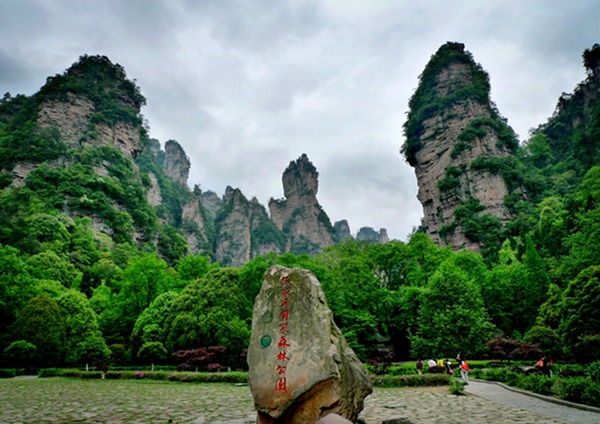
A joke doing the rounds on the Internet says that if Tang Dynasty (AD 618-907) poet Li Bai were living today, he could have composed only half of the poems about the beautiful scenery across China because of skyrocketing prices of tickets to tourist sites. Besides, tourism services are really poor in many places and travel costs in sharp contrast to the quality of service delivered. Just a few days ago, a man in his 70s from Anhui province, surnamed Yao, wrote to Hainan province governor Jiang Dingzhi, complaining about being insulted by his tourist guide on Hainan island for refusing to pay the extra cost to visit the scenic spots he was scheduled to. Later, the tourist guide "dumped" Yao to fend for himself in an unknown place. Yao is not the only one to be ill-treated by tour operators in Hainan, which aims to be an international tourist hub. Early this year, some tourists complained that they had to pay 4,000 yuan ($626) for just three dishes. Though Hainan officials have vowed to make more efforts to create a tourist-friendly environment and improve their tourist services, the related authorities, together with those in other parts of the country, should try to find the root cause of the poor tourist service. To gain greater competitive edge and attract more tourists, many travel agencies have advertised economy package tours at lower-than-normal prices, making it barely profitable for agencies and tour guides both. Therefore, their main means of making money is forcing tourists to visit self-funded scenic spots and shops. Many tour guides are not even paid by their employer agencies and have to rely on commissions from scenic spots and shops where they cajole or coerce tourists to go. For example, the money Yao paid to the travel agency in Anhui hardly covered his tickets to and from Hainan. That means, the Anhui agency "sold" the tourists to the Hainan agency for a song, so the latter forced tourists like Yao to pay an extra 600 to 900 yuan. Such tours leave a sour taste in the mouth for a long time. Many tourists who choose package tours find their trips rather tiring, troublesome and less satisfying than they had expected. Everything seems to go wrong. They can only spend one hour or even less at one scenic spot, merely enough to take a brief look at the scenery, click some photographs and then board the bus heading for the next site. The process is repeated day in and day out across the country. The rising prices of tickets to tourist sites - becoming increasingly unaffordable for ordinary people - is another painful aspect of the tourism industry. The price of a ticket to Zhangjiajie, a famous scenic spot in Hunan province, is 245 yuan, almost three times that of 10 that one has to pay to enter France's Louvre Museum. And to think that France's per capita GDP in 2011 was $44,008 compared with China's $5,413. Worse, exorbitant entry fees charged by tourist sites do not necessarily mean good quality service. Sometimes, restaurant waitresses, vendors around tourist sites, and even local guides and team escorts turn a cold shoulder to reasonable requests of tourists. So what needs to be done? China's tourism industry could start with implementing better regulation and management. Tourism authorities can improve the situation by setting up a strict and effective system of supervision and complaint-punishment mechanism, rather than indulging in empty talks to pacify angry tourists and netizens. Professional training offered to tourism-related service staff is equally important. Also helpful would be the introduction of "mystery customers", a practice with many of the World Top 500 enterprises. A "mystery customer" is a covert assessor who experiences and objectively reports on the quality of service delivered by a shop, a restaurant or a business when customers come into contact with staff members. Source:China Daily
2012-07-30 22:36
View:1641
-
BEIJING, July 30 (Xinhua) -- Although most Chinese parents don't give a second thought about spending lavishly on their children, the mother of Xiang Miao, a high school sophomore who partook in a 16-day summer study tour abroad last year, regrets her careless spending. Xiang's mother paid 30,000 yuan (4700 U.S. dollars) for the so-called "overseas study tour," which boasts of homestay accomodation, collective learning and sight-seeing activities in a foreign country. "I would rather have taken him abroad myself if I had known about this kind of study tour. It is an eye-opener at best, rather than a way of truly enhancing his English skills or making preparations for future overseas study," she said.However, the number of applicants for such programs still saw "explosive" growth this year, according to Zhou Xiaolan, director of the marketing department at the New Oriental Education & Technology Group, a major Chinese education company.More than 10,000 students in Beijing alone will travel abroad for the group's summer study tour, more than the total for last year. "Tour packages to popular destinations such as the U.S. and Britain were booked up three months in advance and less costly tours were also nearly packed," she said. Chinese parents usually give their children a wide variety of choices when it comes to how and where they spend their summer vacation. With the affluence of the Chinese middle class growing all the time, such choices are no longer limited to domestic locations. A three-week trip may cost anywhere from 20,000 yuan to 43,000 yuan, depending on the destination. Most of the applicants are middle school students who have at least two to three years to wait before taking the national college entrance examination. Parents generally expect their children to gain a great deal from their overseas experience, and some have purposefully put their children in such programs as a warm-up before future overseas study. However, observers have warned prospective students and their parents to take caution, warning against profiteering and other shady practices. Parents have reportedly complained about too many sight-seeing and shopping activities instead of programs that can help their children improve their language and communication skills. Suzhou-based lawyer She Bin still worries about his son She Tinghui going abroad, even though the boy has already been abroad by himself once before. The boy is currently on a 12-day trip to the U.S., having already been to Singapore previously. "When he was in Singapore, he was aware that his Singaporean counterparts developed stronger skills in problem-solving. I believe that influence was important for his growth," said She Bin. The elder She recommended government-guided programs or those organized by schools and education authorities. Jiang Nan, an adviser for "global study tour" programs, advised parents to make sure they are clear about the purpose and schedule of any trip they choose to sign their children up for. "When checking the itinerary and credentials of the program's organizer, parents have to make sure at the same time that their children are really interested in exploring the place they are going," he said. Source: Xinhua
2012-08-01 22:31
View:1515
-
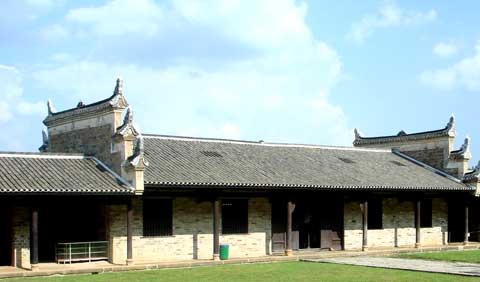
Situated in Heye Town, Shuanfeng County, Loudi, the tourist area is rich in tourism resources, and the representative buildings include Fuhou Hall, Baiyu (White Jade) Hall and Gold Hall. Fuhou Hall was the former residence of Zeng Guofan, the chief of the Hunan army at the end of the Qing Dynasty (1636-1912), and now it is a key historic monument under provincial protection.Transport: It takes only 30 minutes by car from Shuanfeng County to the destinationTel:(86)738-6012899Adimission(for reference): RMB 50 yuan/adultOpening hours: 8:00-18:00
Hot
2022-08-27 17:29
View:5107
-
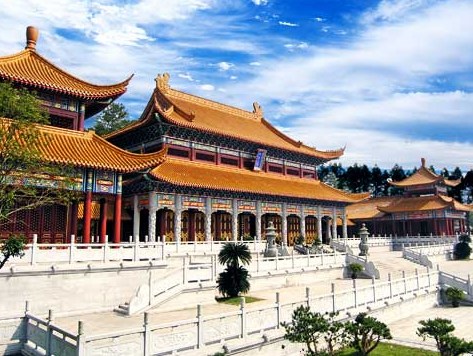
Situated on Luyuan Slope west of Yanling County, it is a national AAAA scenic area. Among the tourist attractions in the scenic area, the most important one is Emperor Yan\\\'s Mausoleum which is a State Preservation Unit of Key Historical Relics and a national AAAA tourist zone. The mausoleum was built in 967 AD during the North Song Dynasty to commemorate Emperor Yan, one of the earliest ancestors of the Chinese people. In 2005 it was listed in the Top Ten Cultural Relics of Hunan Province. Other attractions include Emperor Yan Temple,Chongde Memorial Archway, Luyuan Pavilion, Saint Fire Terrace and Luyuan Cave. Over the past hundreds of years, sacrificial ceremonies have been held in front of Emperor Yan\\\'s Mausoleum. Now it is a sacred place for all the descendants of Emperor Yan and Huang in the world to seek their roots and pay homage to their earliest ancestors. Transport: Buses go from Yanling County to Emperor Yan\\\'s MausoleumTel: (86)731-26100857Admission (for reference): RMB 45yuan /adult Opening hours: 08:00-17:30
Hot
2021-08-28 17:01
View:4939
-
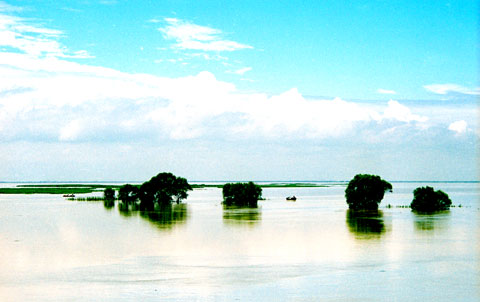
In the east of Yuanjiang City and southwest of Dongting Lake, the wetland has the geomorphologic features of marshland, and is the largest area growing reed-like perennial herbs in the world. It is home to over 10 species under first-class state protection. The South Dongting Lake Wetland contains over 20 natural scenic spots, such as grasslands on the water, a willow forest that stretches over 100 miles, a vast marsh as well as Petal Mountain.Transport: Mini buses from Ziyang Bus Station in Yiyang City to Yuanjiang County can reach the scenic spots.
2016-08-12 16:59
View:3318
-
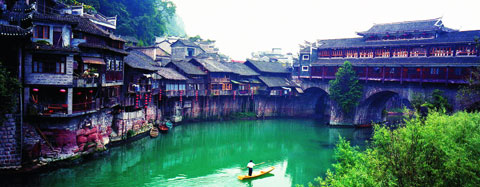
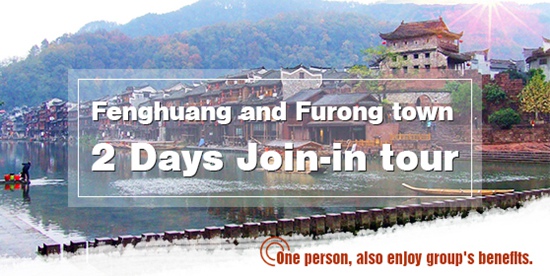
In the northwestern part of Hunan Province, Xiangxi Tujia&Miao Autonomous Prefecture inhabit the ethnic groups of Tujia, Miao, Hui, Yao, Dong and Bai. Within its boundary are high mountains and many rivers. The miraculous natural scenery and colorful ethnic customs present the charm of mysterious Xiangxi.The Mengdong River Scenic Area in the northeastern part of Xiangxi boasts the 1000-year-old town of Laosicheng and ancient town of Wangcun. Visitors can raft on the Mengdong River. Jishou Dehang in the central south is inhabited by a community of the Miao ethnic group. Visitors can join the local inhabitants at their bonfire gatherings. The Fenghuang(Phoenix) Ancient City is known as the \"most beautiful small city in China\", where visitors can appreciate bamboo houses propped up by wooden supports along the Tuojiang River. The tranquil surroundings in Mount Nanhua present a beautiful and unearthly saint. There are also other tourist attractions such as Qiliang Cave in Fenghuang(Phoenix) Ancient City, Baxian Lake in Jishou, the Grand Canyon in Mount Wulong and the Gumiao River in HuaYuan County.
2012-08-06 16:50
View:3871
-
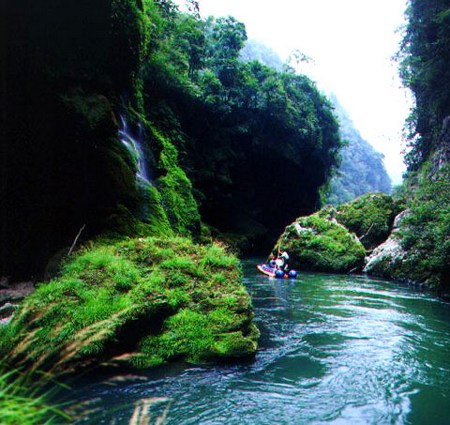
The 112-kilometer-long river originates in Longshan County. In the lower reaches, it joins You River, and goes into Yuan River. It was named Mengdong River after the hole in its sources in Mengbi Vally in Longshan County. Nowadays, the Mengdong River scenic spot is famous largely as an ideal place for rafting. Here visitors can raft on it in rubber boats, and because of the fantastic scenery and unforgettable experience, it gains the praise as the \"number one rafting in the world\".Mengdong River is one of the sources of the culture of Tujia nationality. One can know more about the history, culture and customs of Tujia nationality by visiting the Old Town of Wang Valley,Tujia History Museum, Tujia Custom Museum. At the same time, one can take part in various cultural activities.Transport: Visitors can take a taxi from Wangcun Town to reach hereTel: (86)743-5853367.Admission (for reference): RMB168 yuan/adult:Opening hours: 08:00 -18:00
2012-04-11 16:45
View:4981
-
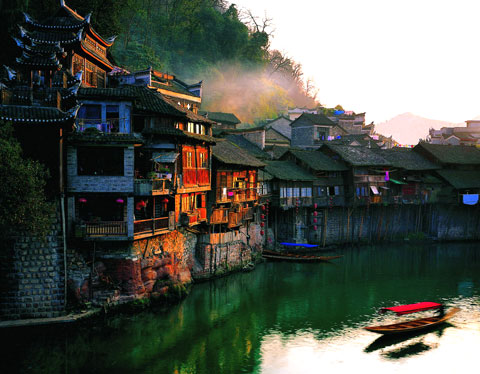
Situated in the western border area of Hunan Province, Fenghuang(Phoenix) Ancient City is a famous historic and cultural city. It was ever praised as "the most beautiful small city in China" by Rewi Alley, a renowned author in New Zealand.
Hot
2021-05-22 16:44
View:10058
-
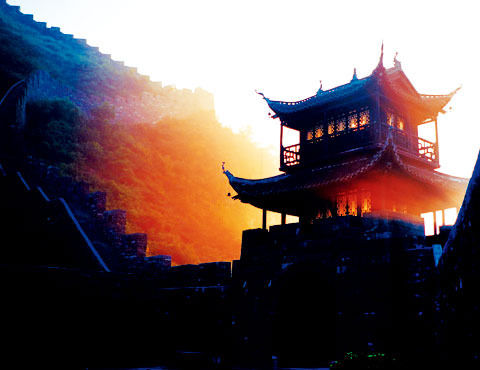
The Southern Great Wall is 10 kilometers away from Fenghuang(Phoenix) Ancient City. It was in April 2,000 that archaeologists discovered more than 190 kilometers of ancient wall, whose structural and military systems were the same as those of the northern Great Wall. Experts confirm that it is part of the Ming Dynasty Great Wall built to defend the kingdom against the Miao people of the south.The wall is about 3 meters high and its basement is about 2 meters wide. It revolves around mountains and cuts across water. The most part of it is built on the precipitous ridges. There are more than 800 whistle terraces, gun emplacements, blockhouses, and outposts used for stationing troops and defending. At that time, often there is a troop of 4,000 to 5,000 soldiers. Now two sections of the wall are still standing: one is in Liaojiaqiao Town and the other in Jixing Town. The section in Liaojiaqiao Town has been renovated 1,780 meters for visitors to appreciate.Transport: Shuttle buses from Fenghuang Ancient City to here are available.Tel: (86)743-3771309.Admission (for reference): RMB 45 yuan /adult:Opening hours: 07:30-18:00
2012-08-06 16:41
View:3965
-
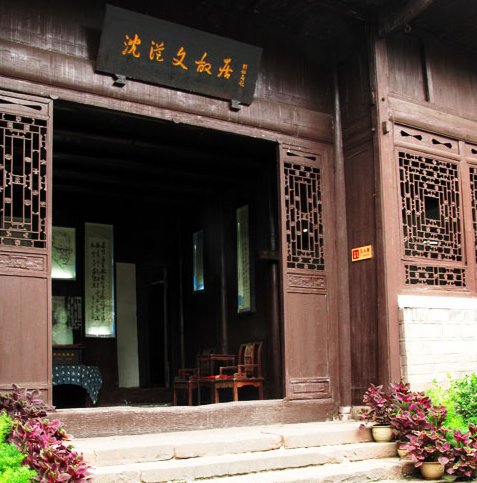
The Former Residence of Shen Congwen who was a famous litterateur and educator, is situated in the Fenghuang(Phoenix) Ancient City. The residence is a typical spacious ancient courtyard with special tectonic style of Ming and Qing Dynasties. It was constructed over 100 years ago by Shen Congwen\'s father when serving in the Qing imperial government. Shen Congwen was born in this house in 1902, and spent his childhood there until he was 15. With a modest size, the wooden houses are roofed with dark gray tiles. The courtyard is paved with dark gray stone slabs with a large water vat in the middle. There are totally eight rooms in which Shen Congwen\'s pictures, original hand written essays, and copies of his works are on display.Transport: Visitors can go there by bus from Jishou Tel: (86)743-3213437.Admission (for reference): RMB60 yuan /adultOpening hours: 07:30 -18:00
2012-08-06 16:38
View:3276